John's ham radio blog
  • Blog
    • SOTA
    • GMA
    • DLFF
    • Portabel
    • Ausrüstung
    • Recht und Urteile
    • Veranstaltungen
    • QSL
    • Software
    • US Amateurfunk Lizenz
    • Sonstiges
    • Satellite
  • DK9JC / AK9JC
    • Mein QRZ.com
  • Awards
    • SOTA
    • GMA
    • FT8 DMC
  • My gear
  • My Logs

Amateurfunk auf dem Mond? ARISS bereitet die Zukunft vor

Details
John, DK9JC & AK9JC
Satellite
22 May 2026
Amateurfunkstation auf einer Mondbasis mit Funkverbindung zu einem Raumfahrzeug im Mondorbit

Die Amateurfunkorganisation ARISS blickt auf mehr als 25 Jahre erfolgreicher Funkkommunikation mit der Internationalen Raumstation ISS zurück. Nun richtet sich der Blick bereits auf die nächste große Herausforderung: die Rückkehr des Menschen zum Mond.

Im Rahmen eines Vortrags auf der Hamvention 2026 stellte ARISS neue Pläne für die Zukunft vor. Gemeinsam mit der AMSAT wurde die Initiative „Amateur Radio Exploration“, kurz AREx, ins Leben gerufen. Ziel ist es, Amateurfunk künftig auch bei Mondmissionen einzubinden.

Noch befinden sich viele Ideen im Konzeptstadium. Dennoch zeigen die vorgestellten Überlegungen, welche Möglichkeiten moderne Amateurfunktechnik inzwischen bietet. Diskutiert werden unter anderem Sprach- und Datenverbindungen über große Entfernungen sowie die Übertragung von Bildern und Videodaten.

Für Funkamateure wäre dies ein weiterer Meilenstein in der Geschichte des Amateurfunks im Weltraum. Bereits heute ermöglichen Satelliten, die ISS und zahlreiche CubeSat-Projekte spannende Verbindungen jenseits der Erdatmosphäre.

Auch wenn konkrete technische Details bislang noch nicht feststehen, unterstreicht das Projekt die Bedeutung des Amateurfunks als Experimentierfeld für Kommunikationstechnologien.

Mit den geplanten Artemis-Missionen der NASA beginnt in den kommenden Jahren ein neues Kapitel der bemannten Raumfahrt. Es bleibt spannend zu beobachten, welche Rolle der Amateurfunk dabei spielen wird.
Quellen

  • ARISS International
  • NASA Artemis Program

Affordable LNAs for Satellite Operation – First Impressions and Ongoing Tests

Details
John, DK9JC & AK9JC
Satellite
28 August 2025
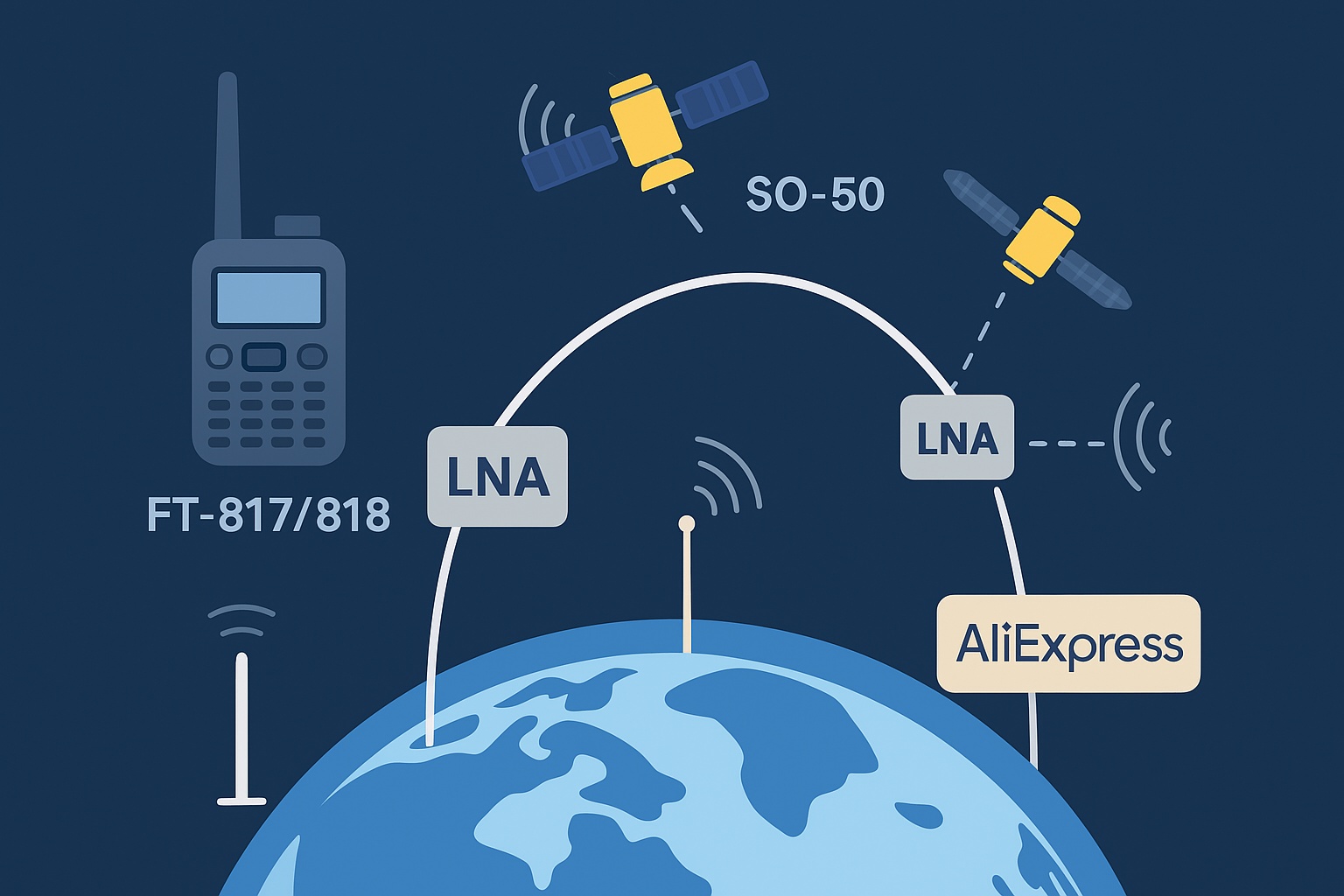
Chinese LNA for LEO Satellites

Introduction

Working LEO satellites with small portable rigs is a lot of fun. Radios like the Yaesu FT-817/818 and the Icom IC-705 are extremely popular because they are lightweight, cover both 2 m and 70 cm, and are easy to use in the field.

But there is a catch: their receivers are not very sensitive on VHF and especially UHF. On weak satellite downlinks, this lack of sensitivity becomes a real problem. That is why external Low Noise Amplifiers (LNAs) are so valuable.

In this article, I want to share my first tests with inexpensive Chinese LNAs from AliExpress. These are globally available, very low cost, and could help hams everywhere — including those in developing countries — to improve their satellite reception dramatically.

This article will be continuously updated as I test more LNAs and collect measurement results.

Why LNAs Matter for LEO Satellites

When receiving weak downlink signals, the noise figure (NF) of the receiver is critical. A lower NF means that the signal is more audible above the noise floor. Unfortunately, the portable radios we love are not strong performers here.

Icom IC-705

Independent lab tests (VA7OJ/AB4OJ) measured:

  • 144 MHz: NF = 17 dB (Preamp OFF), 6 dB (Preamp ON)
  • 432 MHz: NF = 19 dB (Preamp OFF), 7 dB (Preamp ON)

So even with the internal preamp enabled, the IC-705 still sits at 6–7 dB NF — not great for weak satellite signals.

Yaesu FT-817 / FT-818

Reliable NF numbers are harder to find. Based on sensitivity specs and user reports, their performance appears similar to the IC-705 — “deaf” without a strong external preamp.

Read more: Affordable LNAs for Satellite Operation – First Impressions and Ongoing Tests

100 DXCC reached only on Greencube IO-117 SAT

Details
John, DK9JC & AK9JC
Satellite
08 May 2024
V51DM DK9JC Greencube

With the help of Derek, V51DM in Namibia I reached 100 DXCC on Greencube IO-117 only. I have no homestation, so this was either done fully battery powered from portable or with my 10 ele Alaskan Arrow antenna handheld. I did my first QSO on Greencube in Feb 2023, so it took roughly 15 months to reach this milestone. GreenCube, also known as Italy OSCAR 117, or IO-117 for short, is an Italian technology testing and amateur radio satellite in 3U-CubeSat format. The project is coordinated by the Italian Space Agency (ASI) and took advantage of a launch opportunity offered by ESA. At the end of the mission, the satellite was recently taken over by AMSAT Italia.

Read more: 100 DXCC reached only on Greencube IO-117 SAT

DK9JC & VK6PY setting new distance record on IO-117 Greencube

Details
John, DK9JC & AK9JC
Satellite
20 November 2023
VK6PY and DK9JC: IO-117 record
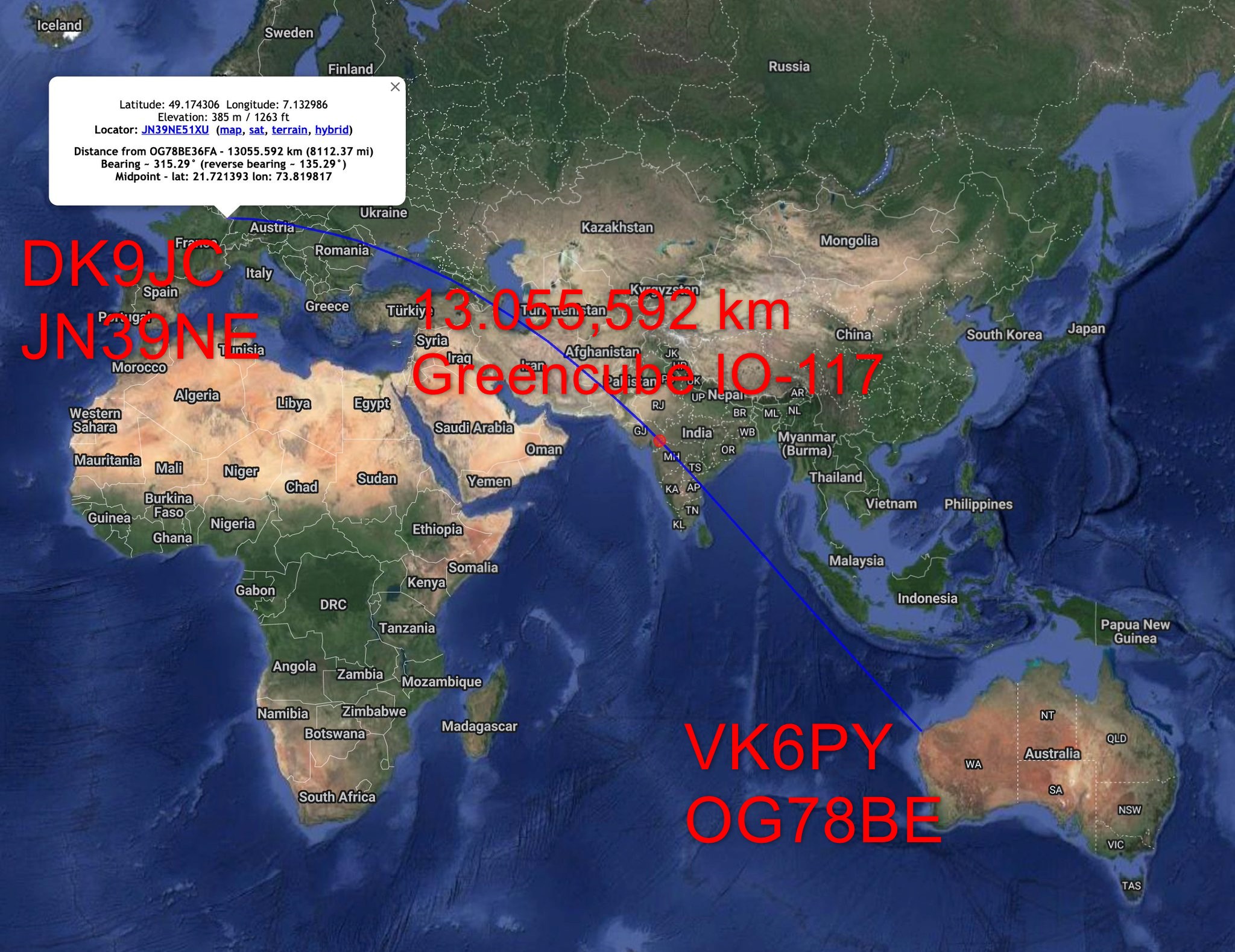
As announced by AMSAT in the USA on Saturday afternoon, John, DK9JC and Mark, VK6PY beat the previous distance world record on "GreeCube" on Tuesday. The former record was 12,966km and was set in January 2023.
 
"This took a few weeks of preparation. I first contacted Mark, VK6PY, at the beginning of October. Over the next few weeks, the overlaps (the so-called "footprint") were calculated and updated based on the current radar data. We had to find the optimum footprint. This was not so easy, as there was hardly any overlap. Mark also had to drive about 1,200km (each way) to get from his home in Perth, Australia, to the far north-western tip of Australia. This was unclear until about a day before the date, because while it was raining constantly in Germany, Mark had bushfires at the planned location," says John DK9JC.
 
In the end, everything worked out.
 
The new confirmed distance of 13,056km (8,112 miles) is now listed on the AMSAT website under " Satellite Distance Records". DK9JC was in JN39NE and Mark, VK6PY was in OG78BE.
 
Both stations were portable and battery powered. They each used 15-element yagis with 14.8 dBi gain and low-noise preamplifiers.
 
The following gear was used:
 
VK6PY: 15 ele diamond A430S15, JG LNA JG-ULNA70VOX (blue tube), IC-9700
DK9JC
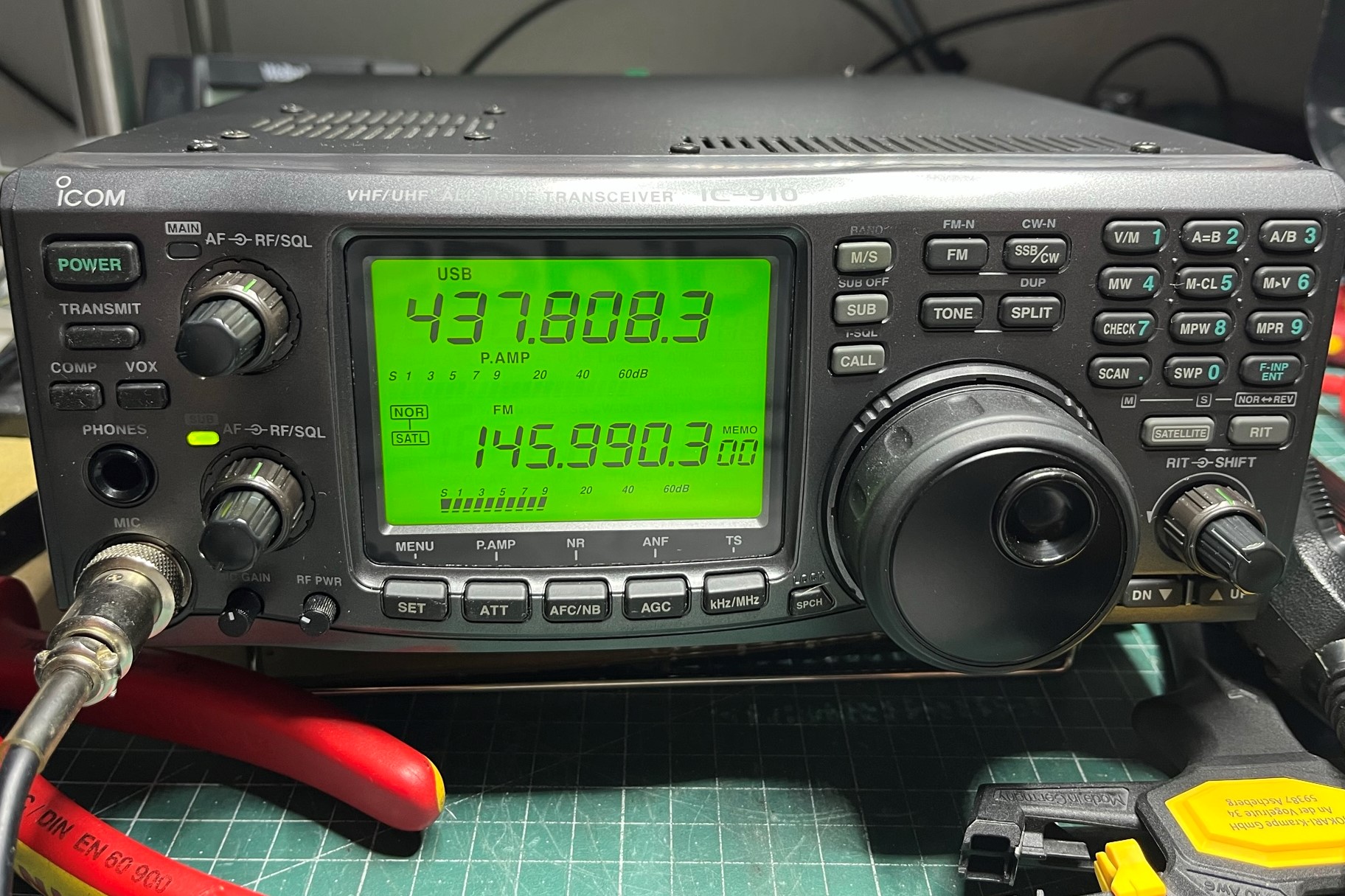
: 15 ele diamond A430S15, JG LNA ULNA70VOX-E, IC-910
 
GreenCube (also known as Italy OSCAR 117, or IO-117 for short) is an Italian technology testing and amateur radio satellite in a medium earth orbit (MEO) at an altitude of around 5800 km.The digipeater transmits in the 70cm band and is currently the only usable satellite in such a high orbit.
 
 
Read more: DK9JC & VK6PY setting new distance record on IO-117 Greencube

FT4 via LEO SAT IC-910H SatPC32

Details
John, DK9JC & AK9JC
Satellite
10 February 2023
Icom IC-910

I recently bought an Icom IC-910H. It was in extremely good condition and came with a dealer warranty. I just had to buy it. For SSB/Digi on SAT I only had my FT-817 and FT-818 and I wanted something with better internal filters and more power. Also, FT-817 and FT-818 can't do doppler correction while transmitting. During TX the 817/818's CAT is not responsive so I wanted something else.

In this post I explain what you need to do with an IC-910 for FT4 via SAT.

Read more: FT4 via LEO SAT IC-910H SatPC32

How to log a Satellite (SAT) QSO in Log4OM [QSL, eQSL, LOTW]

Details
John, DK9JC & AK9JC
Satellite
24 November 2022
Log4OM_SAT_QSO

Even though I have been using cloudlog to log my SAT QSOs for a long time, I would like to explain here how to log a QSO in Log4OM so that it also works as a SAT QSO in LOTW, eQSL and paper QSL (label).

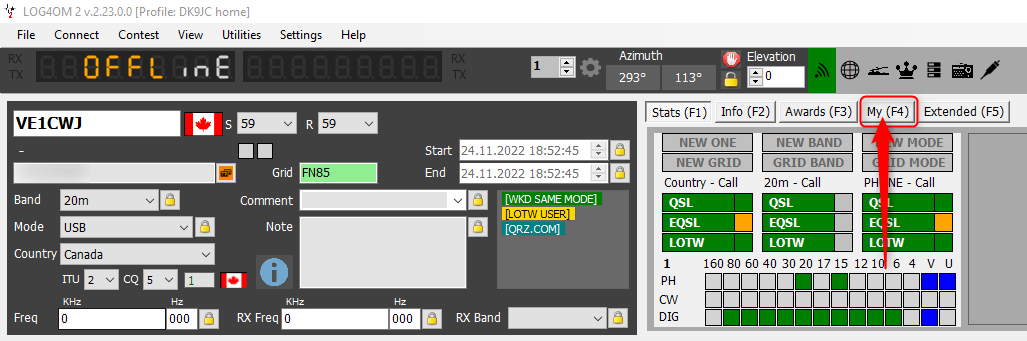
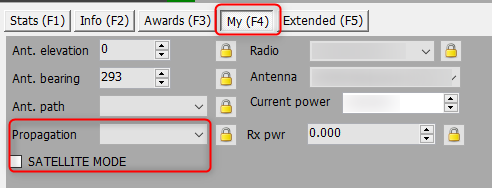
If we entered a callsign we click to "My".

2022-11-24_19h52_51.png

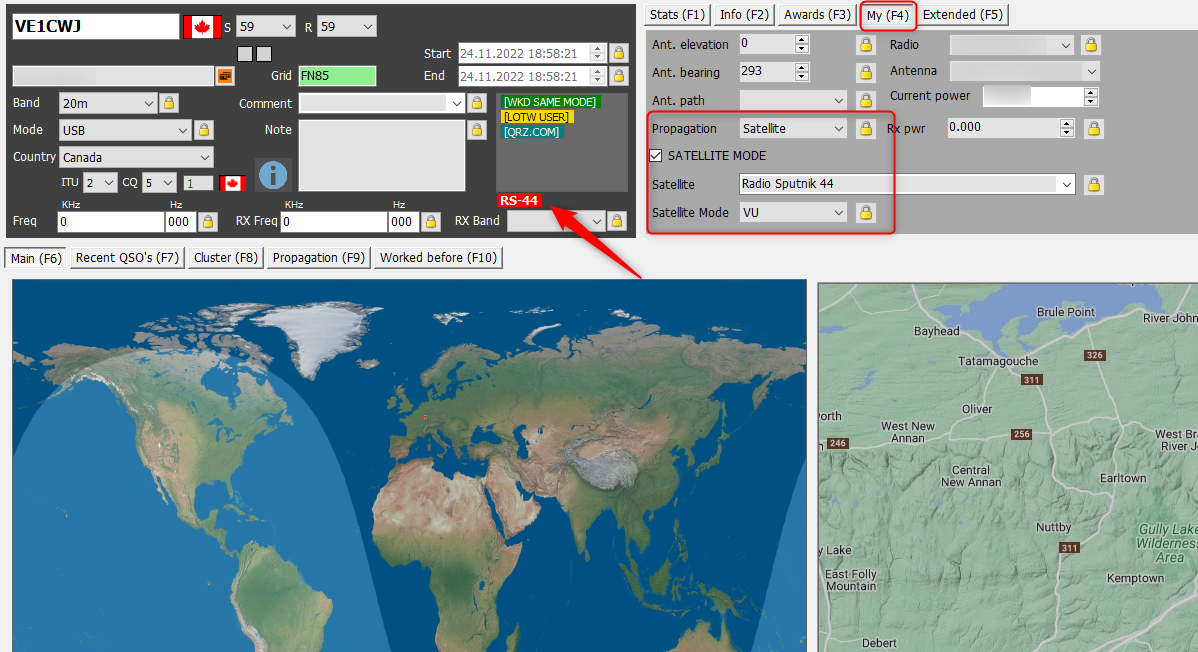
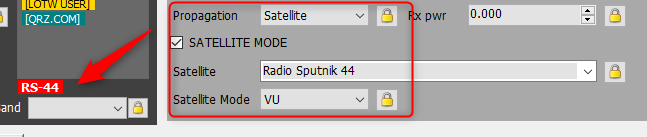
Then we chose Satellite in the drop-down menu unter "Propagation". We also need to check the SATELLITE MODE box.

2022-11-24_19h54_03.png

Now we fill out these fields and we see "RS-44" on left and can chose VU.

2022-11-24_19h56_01.png

Without the correct SAT Name and Propagation mode set to Satellite it is not possible to get a LOTW cfm. All those values need to be correct.

How to add other SATs?

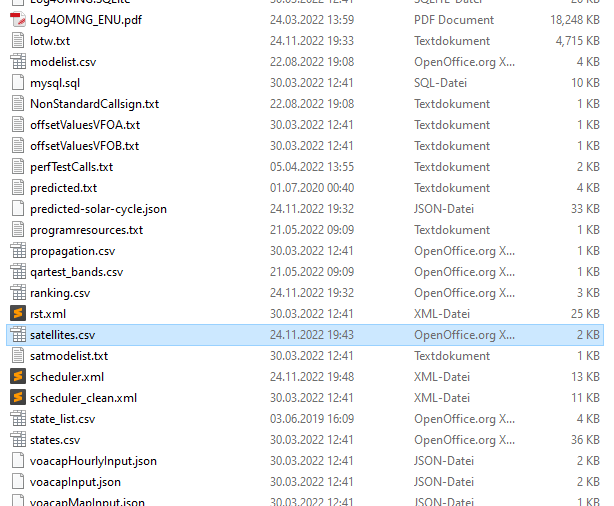
In the current version 2.23.0.0 the most popular LEO SAT RS-44 is missing, but this is not a problem. Log4OM simply uses a CSV file as database. We can edit this file to fit the LOTW name list. This step is important. If you add an own name, LOTW will never get a match and the QSO will still be unfonfirmed. All missing and new SATs can be added.

The file "satellites.csv" can be found under C:\Users\[YOURNAME]\AppData\Roaming\Log4OM2:

2022-11-24_19h51_00.png

I just added this line:

2022-11-24_19h51_42.png

Just comment if you have any questions regarding Log4OM and Satellite QSOs.

More Articles …

  1. July, 23 2022: Contact with Kjell Lindgren NA1SS aboard the International Space Station (ISS)
  2. FT-817 FT-818 8x7 doppler correction with Gpredict
  3. Receiving ISS SSTV images - Expedition 66 - ARISS Series 19 Lunar Exploration
Page 1 of 2
  • Start
  • Prev
  • 1
  • 2
  • Next
  • End
  • 60m
  • DP1POL
  • ARDF
  • GM1200
  • Hochberg
  • WWFF
  • Drehko
  • Amateurfunkpeilen
  • FT-450
  • FT-891
  • Prüfung
  • Bundesnetzagentur
  • IC7300
  • US-Lizenz
  • Li-Po
  • QRP
  • 187
  • NA1SS
  • Ham Radio
  • EARTH MOON EARTH

Beliebteste Beiträge

  • Magnetic Loop (Magnetantenne) selber bauen (DIY magnetic loop antenna)
  • Baofeng BF-888S Test und Programmierung (Pofung)
  • MX-P50M 50W HF Power Amplifier für FT-817 und KX-3
  • DIY Kits 70W SSB linear HF Power Amplifier FT-817 KX2 KX3
  • Ascom SE540 BOS-Funkgerät - Umbau auf Amateurfunk
  • Li-Ion battery pack (18650s) for the FT-817 and KX2 and comparision on RC Li-Po and LiFePo4 packs
  • US Extra-Class bestanden
  • Amateurfunk Klasse E (CEPT-Novice) – Erfahrungen nach knapp einem Jahr
  • Mag Loop Magnetic Loop DIY with trashed 26 inch bicycle rim
  • APRS Kabel für Baofeng und APRSdroid selbst gebaut
  • RSS
  • Links
  • Login
  • Impressum
  • Datenschutzerklärung

Twitter Social Icon RSS Social Icon

Follow me on Twitter Social Icon RSS Social Icon

Amateurfunk-Blog.de / DK9JC.de 2014 - 2026

Bootstrap is a front-end framework of Twitter, Inc. Code licensed under MIT License. Font Awesome font licensed under SIL OFL 1.1.